
Simon’s November 2025 Surgery: Why It Wasn’t “Just” One Procedure!
In November 2025, Simon returned to BC Children’s Hospital for what was technically one surgery — but medically, it involved four separate procedures.
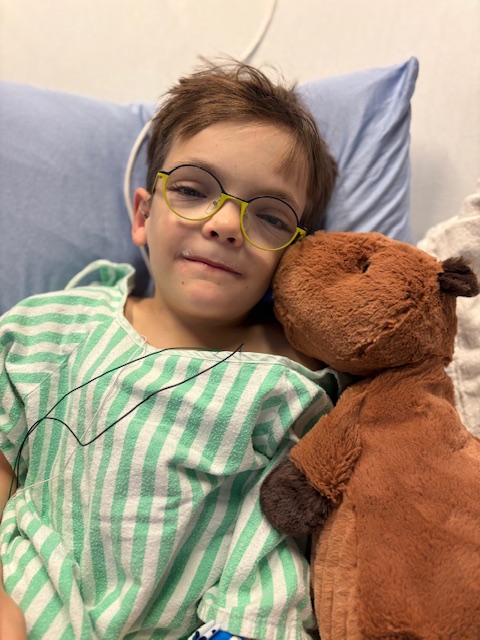
For children with Morquio (MPS IVA), surgery is rarely simple. The disease affects bones, joints, airway structures, and the spine. It is progressive and systemic, which means interventions are often ongoing rather than one-time fixes.
This operation included:
- Removal of hip plates and screws from his previous double hip osteotomy
- Placement of new 8-plates in both upper legs for guided growth
- Removal of tonsils and adenoids to treat obstructive sleep apnea
- A comprehensive airway assessment
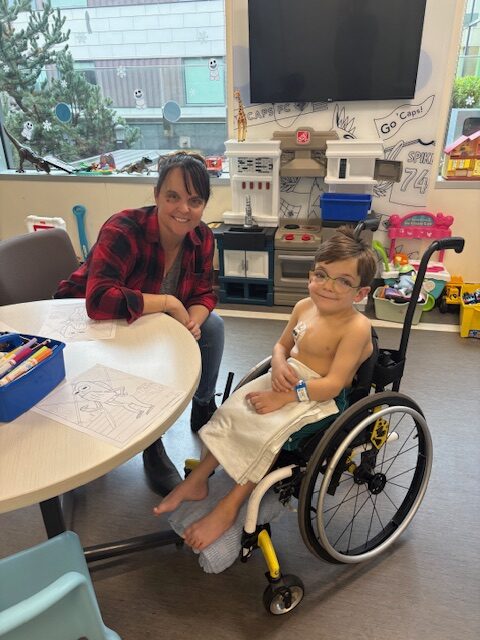
Why Combine So Much at Once?
Children with Morquio face elevated anesthesia risks due to:
- Cervical spine instability
- Narrowed airway
- Skeletal abnormalities affecting intubation
- Increased need for neuromonitoring
Because of this, every anesthetic event carries higher complexity and risk. Whenever possible, procedures are batched into a single surgical event to minimize the number of times a child must go under anesthesia.
That’s why these four procedures were done together — not for convenience, but for safety.
Orthopedic Follow-Up and Guided Growth
In March 2024, Simon had undergone a double hip osteotomy to correct significant hip dysplasia — a common complication of Morquio caused by abnormal bone development.
This recent surgery removed the plates and screws that had stabilized his hips during healing. Hardware removal is a typical step once sufficient bone healing has occurred.
At the same time, surgeons placed new 8-plates near both knees. These small plates are used in guided growth procedures to gradually correct alignment as a child grows. Because Morquio affects cartilage and bone formation, leg alignment can progressively worsen over time. Guided growth is a proactive way to manage that progression.
It is not a one-time correction. It is part of ongoing orthopedic management.
Addressing Sleep Apnea and Airway Risk
Obstructive sleep apnea is common in Morquio due to:
- Enlarged tonsils and adenoids
- Airway narrowing
- Skeletal structure differences
- Tissue thickening
Removing Simon’s tonsils and adenoids was intended to reduce airway obstruction during sleep and improve oxygen levels.
During the same anesthetic, his team conducted a detailed airway assessment. In Morquio patients, spinal curvature and structural changes can impact both the trachea and esophagus. Monitoring these changes early is critical to preventing more serious complications later.
Relentlessness
This surgery was a clear reminder that Morquio requires constant monitoring and repeated intervention.
Even after a major reconstruction like a double hip osteotomy, new orthopedic adjustments are necessary. Even when breathing seems manageable, airway structures must be reassessed. Growth does not pause — and neither does the disease’s impact on bones and tissues.
The need to bundle four procedures into one surgical day reflects that reality.
Simon’s Resilience
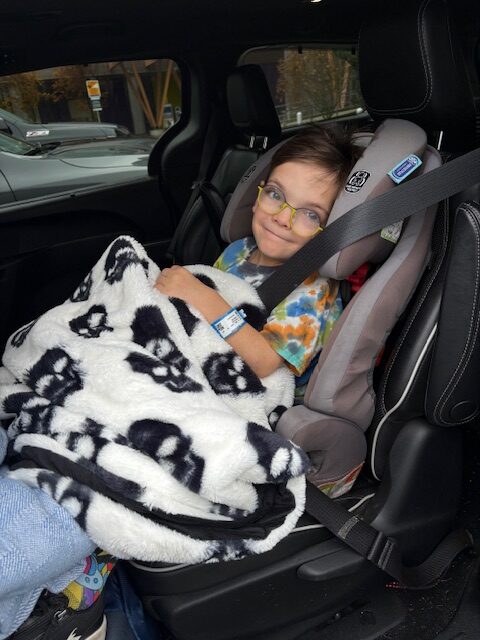
From Simon’s perspective, this meant another hospital admission, another IV, another recovery period, and weeks of healing.
He handled it with the same determination he brings to everything else — adapting, recovering, and getting back to his routines as quickly as possible.
The medical complexity is significant. The emotional and physical demands are ongoing.
And so is Simon’s resilience.
Learn more
Read our story about MPS Type 4A
and how it has changed our lives.
Stay in Touch
If you want updates from us direct to
your inbox, sign up for our email list.